Conical Tesla coil calculator
The turns lie on the slant surface of a cone. A shape often used for the primary of a Tesla coil — it gives better coupling with less capacitance.
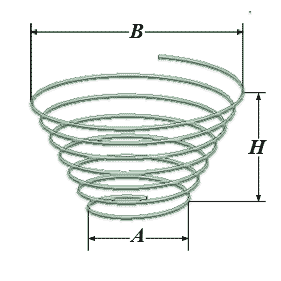
| Cone base diameter A (cm) | |
| Top diameter B (cm) | |
| Cone height H (cm) | |
| Wire diameter dw (mm) | |
| Number of turns N | |
| Result | |
| Inductance L | |
| Pitch along the cone slant | |
| Wire length | |
📐 Formulas
The turns are laid out linearly along the cone:
zᵢ = i·H/(N−1)
rᵢ = A/2 + zᵢ·(B/2 − A/2)/H,      i = 0 … N−1
After that it is the same Maxwell summation as for the cylindrical and flat coils:
L = Σ Lself(rᵢ) + 2·Σ M(rᵢ, rⱼ; zᵢ − zⱼ), i greater than j
The pitch along the slant of the cone:
s = √( (H/(N−1))² + ((B/2 − A/2)/(N−1))² )
If it comes out smaller than the wire diameter the turns overlap, and the calculator says so.
For comparison, the classic Wheeler formulas (dimensions in inches), which are what such coils are usually worked out with:
W = (B − A)/2,   Z = √(W² + H²),   R = A/2 + W/2
L₁ = R²N² / (9R + 10H)          vertical component
L₂ = R²N² / (8R + 11W)          horizontal component
L  = √( (L₁·sinX)² + (L₂·cosX)² )
They are fast, but for shallow cones with a large pitch they are tens of per cent out.
Notation:
A— diameter of the base of the cone [cm]B— diameter of the top [cm]H— height of the cone [cm]dw— wire diameter [mm]N— number of turns
- The turns are treated as perfect circles rather than as turns of a helix — for a large number of turns the difference is negligible
- The model is for an air-cored coil with no core and no shield
- The pitch along the slant must be no smaller than the wire diameter
🎯 Where it is used
- The primary of a conical Tesla coil.
- Work coils of unusual geometry.
- Comparing the conical shape with the flat and cylindrical ones at the same inductance.
- The cone may widen or narrow towards the top — the model works either way.
- A conical primary couples to the secondary better than a flat one and has less capacitance than a cylindrical one. Hence its popularity.
- The calculation here agrees with the rest of the section — single-layer, multilayer and flat spiral all use the same Maxwell formula.
© 2026 UR3PKI · CyberDev.Space · Content licensed under CC BY-NC-SA 4.0.
How to cite this calculator
UR3PKI. «Conical Tesla coil calculator». CyberDev.Space. https://cyberdev.space/en/radio/calculators/coils/conical (licence CC BY-NC-SA 4.0).The licence lets you use this material freely, including in teaching materials, but only with attribution to the author and a link to the source.