Wire-above-plane inductance calculator
When you need this
At UHF any length of wiring above a ground plane is already a piece of transmission line, not just a piece of wire.
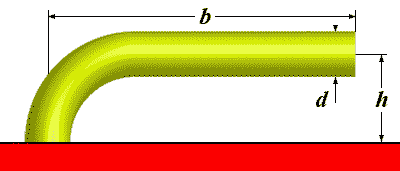
| Section length b (mm) | |
| Height of the wire axis above the substrate h (mm) | |
| Wire diameter d (mm) | |
| Result | |
| Inductance L | |
| The same in microhenries | |
| Characteristic impedance of this line Z₀ | |
| Reactance at 1 GHz | |
📐 Formulas
The inductance is set by the height above the plane: the plane carries the return current, and the loop area is set by the distance between the wire and its mirror image.
L = (μ₀ / 2π) · b · arcosh(2h/d)
In convenient units (b in metres, h and d in the same units as each other):
L [µH] = 0.2 · b · arcosh(2h/d)
The same geometric factor sets the characteristic impedance of this line in air:
Z₀ = 59.95 · arcosh(2h/d) Ω
Notation:
b— length of the run parallel to the plane [mm]h— height of the axis of the wire above the plane [mm]d— wire diameter [mm]Z₀— characteristic impedance of such a line [Ω]
Limits of the calculator:
- This is a lumped-element model: it holds as long as the electrical length of the run is no more than a few degrees
- Closer to a quarter wavelength the run already transforms impedance, and beyond it turns capacitive — then it is a line that has to be calculated, not an inductance
- The height h is measured to the axis of the wire, so it is always greater than d/2
- The dielectric of the board is not taken into account — the formula is for air
🎯 Where it is used
- Estimating the wiring inductance in RF assemblies.
- Working out the inductance of leads and jumpers.
- Checking the characteristic impedance of a line the layout has formed by accident.
Practical notes:
- The characteristic impedance here is not a footnote: if it is far from the impedance of the chain, the run will spoil the match before it starts «adding inductance».
- 50 mm of 1 mm wire at a height of 5 mm gives 30 nH — at 1 GHz that is already 188 Ω. Which is exactly why UHF wiring is kept as short as possible.
- Bringing the wire closer to the ground plane is the simplest way to cut the stray inductance without shortening it.
© 2026 UR3PKI · CyberDev.Space · Content licensed under CC BY-NC-SA 4.0.
How to cite this calculator
UR3PKI. «Wire-above-plane inductance calculator». CyberDev.Space. https://cyberdev.space/en/radio/calculators/coils/wire_above_plane (licence CC BY-NC-SA 4.0).The licence lets you use this material freely, including in teaching materials, but only with attribution to the author and a link to the source.