Foil-wound coil calculator
A multilayer coil wound from thin metal strip with an insulating interleaf. Typically secondaries and work coils, where low self-capacitance and a large conductor perimeter matter.
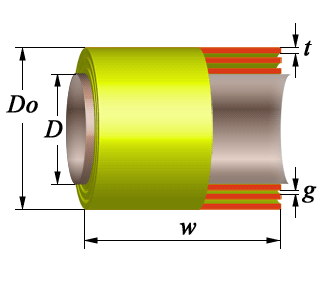
| Required inductance L (µH) | |
| Former diameter D (mm) | |
| Foil width w (mm) | |
| Foil thickness t (mm) | |
| Gap between turns g (mm) | |
| Result | |
| Number of turns N | |
| Outer winding diameter Do | |
| Foil length Lth | |
| Resistance of the copper foil | |
📐 Formulas
Strip cannot be treated as round wire of equivalent cross-section: the inductance depends not on the area but on the geometric mean distance of the cross-section, and the GMD of a long thin rectangle differs from the GMD of a circle of the same area by a large factor.
Self-GMD of a strip:
ln(GMD) = ln(w) − 3/2 → g_self = e^(−3/2)·w ≈ 0.2231·w
The mutual GMD of two strips separated radially by s:
ln(GMD₁₂) = (s²/w²)·ln(s) + ½·(1 − s²/w²)·ln(w² + s²)
          + 2·(s/w)·arctg(w/s) − 3/2
The pair of strips is then replaced by an equivalent pair of filaments whose radial separation equals the mutual GMD and whose product of radii is preserved:
R₁ − R₂ = GMD₁₂, R₁ · R₂ = r₁ · r₂
For that pair the ordinary Maxwell formula applies.
Notation:
L— inductance [µH]D— former diameter [mm]w— strip width [mm]t— strip thickness [mm]g— gap between turns [mm]Do— outer diameter of the winding [mm]
- The strip must be at least 100 times wider than it is thick — otherwise the cross-section is no longer a «strip» and the GMD formula does not apply
- The strip width cannot exceed the former diameter
- Skin and proximity effects are not modelled: on alternating current the real resistance will be higher
- The stated accuracy is no worse than ±10 % as long as the strip is narrower than the former diameter
🎯 Where it is used
- Work coils in induction heaters.
- Tesla coils with strip windings.
- High-current chokes, where round wire would suffer too much skin effect.
- The resistance shown is for copper strip. For aluminium multiply by 1.6.
- For the same cross-section a strip has a larger perimeter than round wire — which is exactly why it wins on losses at high frequencies.
- The gap between turns sets not only the size but also the self-capacitance. A thinner interleaf means a more compact coil and a lower resonant frequency.
© 2026 UR3PKI · CyberDev.Space · Content licensed under CC BY-NC-SA 4.0.
How to cite this calculator
UR3PKI. «Foil-wound coil calculator». CyberDev.Space. https://cyberdev.space/en/radio/calculators/coils/foil_winding (licence CC BY-NC-SA 4.0).The licence lets you use this material freely, including in teaching materials, but only with attribution to the author and a link to the source.