Triangular loop inductance calculator
When you need this
A loop shaped as an isosceles triangle: two sides and a base. The classic shape of a delta loop and of many home-made loop antennas.
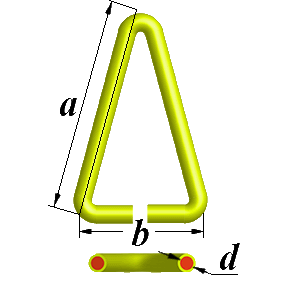
| Side a (m) | |
| Base b (m) | |
| Wire diameter dw (mm) | |
| Permeability of the wire material μ | |
| Result | |
| Inductance L | |
| The same in nanohenries | |
📐 Formulas
A closed-form formula for a loop of three straight segments of round wire:
q = √(4·b²·a² − b⁴)
r = dw / 2

L [µH] = 0.2·μ · [ 2a·ln(2a/r) + b·ln(2a/r)
                     − 2(b + a)·arsinh(b²/q)
                     − 2a·arsinh((2a² − b²)/q)
                     − (2a + b) ]
Lengths are in metres; arsinh is the inverse hyperbolic sine.
The expression under the root is positive only for b less than 2a — which is the triangle inequality. The calculator checks it explicitly and gives a readable message instead of NaN.
Notation:
a— side [m]b— base of the loop [m]dw— wire diameter [mm]μ— relative permeability of the wire materialL— inductance [µH]
Limits of the calculator:
- The base must be shorter than the sum of the sides: b less than 2a
- A lumped-element model: the perimeter is much smaller than the wavelength
- The wire is round and solid
- The wire must not be too thick relative to the base
🎯 Where it is used
- The delta loop and other triangular loop antennas.
- Coupling turns of an unusual shape.
- Comparing shapes: for the same perimeter a triangle encloses less area than a square, so its inductance is lower too.
Practical notes:
- An equilateral loop with 1 m sides gives about 3.7 µH against 5.5 µH for a 1 × 1 m square — the difference is exactly the enclosed area.
- If the loop is very obtuse (the base almost twice the side), the formula still works, but the accuracy drops: check the result with a meter.
- For antennas it is not only the inductance that matters but the perimeter in wavelengths — work out both.
© 2026 UR3PKI · CyberDev.Space · Content licensed under CC BY-NC-SA 4.0.
How to cite this calculator
UR3PKI. «Triangular loop inductance calculator». CyberDev.Space. https://cyberdev.space/en/radio/calculators/coils/triangle_loop (licence CC BY-NC-SA 4.0).The licence lets you use this material freely, including in teaching materials, but only with attribution to the author and a link to the source.