Rectangular loop inductance calculator
When you need this
A loop antenna, a coupling turn, the loop of a magnetic antenna — anything that is one rectangular turn of wire.
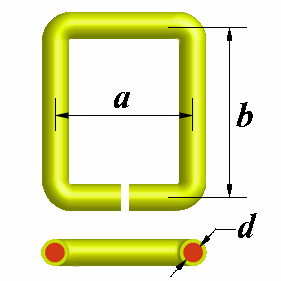
| Loop width a (m) | |
| Loop height b (m) | |
| Wire diameter dw (mm) | |
| Permeability of the wire material μ | |
| Result | |
| Inductance L | |
| The same in nanohenries | |
📐 Formulas
A rectangle of four straight segments: the self-inductance of every side plus the mutual inductance of the opposite pairs with a minus sign. Collected together:
diag = √(a² + b²)
r₀   = dw / 2

L [µH] = 0.4·μ · [ −2(a + b) + 2·diag
                     − b·ln((b + diag)/a) − a·ln((a + diag)/b)
                     + b·ln(2b/r₀) + a·ln(2a/r₀) ]
All lengths are in metres. The factor 0.4 is μ₀/π · 10⁶, i.e. the conversion to microhenries.
Notation:
a— loop width [m]b— loop height [m]dw— wire diameter [mm]μ— relative permeability of the wire materialL— inductance [µH]
Limits of the calculator:
- This is a lumped-element model: the perimeter of the loop must be much smaller than the wavelength, in practice below λ/10
- A longer loop already behaves as a transmission line, not as an inductance
- The wire is round and solid; the skin effect is not taken into account
- The wire must not be too thick relative to the sides of the loop
🎯 Where it is used
- Receiving loop antennas for long and medium waves.
- Coupling turns in tuned circuits and filters.
- Estimating the stray inductance of a ground loop or a supply loop on the board.
Practical notes:
- For reference: copper has μ = 0.999994, aluminium 1.000022, steel around 100. For non-magnetic materials leave it at one.
- A square loop of 1 × 1 m in 1 mm wire gives 5.46 µH. That is a handy benchmark for checking you have not slipped an order of magnitude.
- Thicker wire lowers the inductance — and raises the Q of the loop at the same time. For a receiving antenna that is a double win.
© 2026 UR3PKI · CyberDev.Space · Content licensed under CC BY-NC-SA 4.0.
How to cite this calculator
UR3PKI. «Rectangular loop inductance calculator». CyberDev.Space. https://cyberdev.space/en/radio/calculators/coils/rect_loop (licence CC BY-NC-SA 4.0).The licence lets you use this material freely, including in teaching materials, but only with attribution to the author and a link to the source.