Rectangular-former multilayer coil calculator
When the former is rectangular rather than round — the usual case for home-made chokes on flat bobbins and for coils inside slim enclosures.
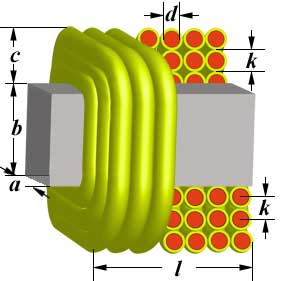
| Required inductance L (µH) | |
| Former width a (mm) | |
| Former height b (mm) | |
| Winding length l (mm) | |
| Wire diameter over copper d (mm) | |
| Wire diameter over insulation k (mm) | |
| Estimate the diameter over insulation automatically | |
| Result | |
| Number of turns N | |
| Number of layers n | |
| Winding thickness c | |
| Wire length Lw | |
| DC resistance of the winding | |
📐 Formulas
The method is the same as for a round former, but a turn is not a circle — it is a rectangle made of four straight segments. That is why Grover's formulas are used here instead of elliptic integrals.
A = a + k + 2·k·layer      the two sides «across the width»
B = b + k + 2·k·layer      the two sides «across the height»
r = k·layer                radial offset of the layer
Self-inductance of a segment:
r_gmd = 0.5·d·e^(1/4)
S(ℓ) = 0.002·[ ℓ·ln((ℓ + √(ℓ²+r²))/r) − √(ℓ²+r²) + ℓ/4 + r ]
The mutual inductance of two parallel segments of lengths m and n spaced s apart (half-lengths α = m/2, β = n/2):
M = 0.002·[ 2α·ln((α+β+√((α+β)²+s²))/s)
          + (α−β)·ln((α+β+√((α+β)²+s²)) / (α−β+√((α−β)²+s²)))
          + √((α−β)²+s²) − √((α+β)²+s²) ]
The inductance of a single turn — opposite sides carry current in opposite directions, so their mutual inductance is subtracted:
L_turn = 2·S(A) + 2·S(B) − 2·M(A,A; B) − 2·M(B,B; A)
Notation:
L— inductance [µH]a— former width [mm]b— former height [mm]l— winding length [mm]d— wire diameter over copper [mm]k— diameter over the insulation [mm]
- A close winding, turn against turn, with no interlayer insulation and no sections
- The former is non-magnetic
- The stated accuracy of the method is about ±5 %
- The calculation is capped at 8000 turns: beyond that it becomes too slow
🎯 Where it is used
- Chokes on flat bobbins in compact designs.
- Coils in slim enclosures, where a round former does not fit.
- Comparison with a round former: a rectangle of the same overall size encloses a larger area, so fewer turns are needed.
- A single square turn of 12 × 12 mm in 1 mm wire gives 23.6 nH. The closed-form formula for a rectangular loop gives 23.1 nH on the same figures — two independent models agreeing to within 2 %.
- Sharp corners concentrate the field and make winding harder: if you have the choice, take a former with rounded edges.
- A rectangular coil radiates outwards more than a round one of the same inductance — in sensitive circuits it is worth shielding.
© 2026 UR3PKI · CyberDev.Space · Content licensed under CC BY-NC-SA 4.0.
How to cite this calculator
UR3PKI. «Rectangular-former multilayer coil calculator». CyberDev.Space. https://cyberdev.space/en/radio/calculators/coils/multi_layer_rect (licence CC BY-NC-SA 4.0).The licence lets you use this material freely, including in teaching materials, but only with attribution to the author and a link to the source.